








Marble vs. Granite: Pros and Cons
Marble and granite are two of the most popular materials for building a home, especially kitchen and bathroom. However, there isn’t a day that goes by when the argument regarding marble vs. granite does not resurface. However, why shouldn’t it? The reason for this is that considering that both choices are relatively inexpensive and stones that are naturally occurring, which means they are both ideal for the interior. But then, how could you ever choose the best to use? Therefore, in order to resolve this, we at A-Class Marble have provided you with a holistic view of these materials by comparing them based on performance, durability, price, and availability.
What is Marble?
Marble is a metamorphic rock made of carbonate minerals which is formed when limestone is subjected to high pressure and temperatures which is covering the earth's crust. The stone undergoes a "metamorphosis" in which the calcite present in the stone crystallizes it into small pieces that change its structure. As the process continues, crystals become larger and get interlocked.
Well, marble is the most exquisite and luxurious natural stone. It has been an imperative part since ancient times. Marbles were highly used as a decorative element or used on a wall or for floor covering. You can easily identify marble from its veining and a range of colors, which includes both monochromatic and polychromatic variations ranging from the most neutral tones (white, gray, or black) to more striking colors such as green, brown, yellow or red.
Pros & Cons of Marble
PROS:
- Marble lasts longer, if maintained properly.
- It has a unique and luxurious appearance.
- Marble is quite affordable.
CONS:
- Marble is a softer stone and that is why it is prone to be etched and discolored, if not maintained properly.
- Marble is vulnerable to stains, hence homeowners won’t generally go for marble in kitchen countertops.
- You need to repair marble twice a year.
What is Granite?
Granite is a granular, incandescent rock with an extremely rough texture that forms from the crystallization of magma beneath the earth's surface. It is mostly made of quartz and feldspar, has rough granularity, and is often light in color. Granite is used in a variety of interior and exterior building applications, including pavement in public places and floor tiles.
Pros & Cons of Granite
PROS:
- Granite is heat-resistant and durable, making it ideal for kitchen countertops.
- It is scratch-resistant, making it great for outdoor landscaping as well.
- Granite is also naturally stain-resistant and if sealed well, it is good-to-go.
- Affordable versions are available; though certain varieties can be expensive
CONS:
- Dark granite slabs aren’t any choice.
- Is susceptible to cracks, if not maintained well.
- If installed in L-shaped and U-Shaped in the kitchen, the cuts will be visible
Marble vs Granite: The Similarities
Marble and granite are both naturally occurring stones that share many similarities. Below are some of them:
- Both marble and granite look aesthetically gorgeous and luxurious.
- Both are highly versatile and non-porous, However, need maintenance to some extent.
Difference between Marble and Granite
Marble is a reference material for cladding and flooring, whereas granite is primarily utilized for kitchen and bathroom counters. Another difference between these two materials is that granite can be used on floors with significant foot traffic, but marble is typically reserved for regions with little traffic.
While both are natural and extracted from the ground, they have significantly distinct qualities. The most notable difference between granite and marble is their absorbency. Marble is softer and more absorbent than granite. Granite is the hardest natural stone due to its crystalline structure, which makes it resistant to staining, abrasion, and discoloration.
Both materials provide elegance to a room, but marble has a sophisticated and exclusive feel that works well in both classic and avant-garde designs. But, what’s the best choice? You must be stuck in between. Well, which one to use for your interior totally depends on the look you want and how you can upkeep it. With this, let’s understand the key differences between marble and granite.
Physical Appearance
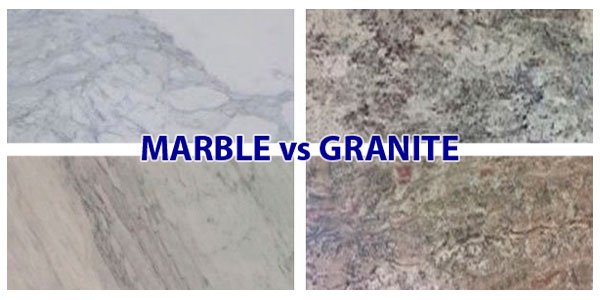
The physical appearance of Granite differs significantly from that of marble. Granite's speckled colors are a result of melded stones within its structure, which include mica, quartz, feldspar, and even amphibole. Furthermore, it is available in a variety of tones and colors.
Marble, on the other hand, is a solid cream or grayish-white stone with dark veins running across it. There may be rare instances of variations with a pink or green base color. The lines on the stone are caused by impurities such as iron oxides and silt. A-class Marble offers premium-grade composite marble that comes in a variety of colors and textures.
Properties
Granite is considered a stronger natural stone. However, both marble and granite are naturally porous, meaning liquids that spill on them can seep into stones, if left untreated. To avoid the frequent downfalls of natural stone materials, homeowners generally opt to install granite materials that are non-porous, heat and stain resistant. The reason is marble has a softer density and is susceptible to heat and acidic spills. One such example is Taj Mahal. You can repair it with sealants but to some extent.
Applications
Granite's innate durability makes it an ideal choice for bathroom and kitchen surfaces. Most households choose granite for flooring. Marble, on the other hand, is more commonly used in low-traffic areas such as restrooms. Natural marble can be utilized for installations on flooring, shower walls, tub decks, and vanities.
Marble gives a unique and light appearance. Therefore, it is an excellent choice for surfaces that are not used much. Apart from this, marble and granite are commonly used in gravestone markers and sculptures.
Maintenance
Natural marble and granite are porous, so they may absorb liquids from spills. At the same time, lighter-colored stones are more porous than darker-colored stones. Sealants can aid, improve, and avoid stains when etched on granite and marble. However, removing typical spills from the surface may prove difficult. Most homeowners now install high-quality composite marble or engineered stone materials that are nonporous and stain-resistant.
Well, marble generally needs resealing and polishing twice a year. On the other hand, granite might also need some resealing, but you don’t need to invest in polishing every year. You can polish the granite every two years or so.
Stain Removal
The ability to remove a stain is determined by whether the surface has deep or permanent damage. Some stains are minor and easy to remove with a stain remover.
Other stains may soak into the stone's pores, causing permanent changes to its chemical makeup. If you're concerned about stains, consider granite, which is intentionally stain-resistant. Because granite stones are nonporous, there is no risk of moisture seeping in or stains developing.
Health Risks
Some granite surfaces may contain trace elements of naturally occurring, radioactive thorium, uranium, and radium. Over time, the aforementioned elements can decay and release radon, a noble gas that, at sufficiently high levels, can cause lung cancer.
If you are concerned about overall health issues, consider installing composite marble or engineered stone materials to alleviate your concerns.
Durability
Although both granite and marble are hard and can last for years, there is one key difference that sets granite apart from marble. That is its non-porous nature. Marble scores 3-5 on the Mohs scale (since it is a softer sedimentary stone), but granite scores 6-7 due to its great density.
Marble is porous and prone to discoloration, spills, stains, and pitting. That is why marble should be polished and sealed before use. It is advised to get marble polished twice a year. Granite, on the other hand, is non-porous, stain and spill resistant, and does not easily discolor.
Pricing
There are various aspects to consider when comparing the prices of marble and granite. Marble is typically less expensive than granite, however this is not always the case, as some marble variants can be rather expensive. Granite prices range from Rs.80 to Rs.2200/sq. ft., depending on look, strength, color, pattern, and availability.
Outdoor Usability
Granite can be used outside, with or without sealer. However, due to its porous nature and tendency to absorb water, marble cannot be utilized outdoors without a sealing barrier.
Marble is also more susceptible to etching and staining because it is a softer stone. Furthermore, all natural stones (even granite) can become slippery when wet. While outdoor granite may perform better than marble.
Marble Vs. Granite: Which Is Better?
There is no such winner, when it comes to deciding marble vs granite. Both natural stones are heat resistant, scratch-resistant, and stain-resistant. Both are non-porous. However, deciding which is better for your home entirely depends on your preferences. This guide has listed down pros and cons of marble and granite based on some aspects. We hope this will assist you in making an informed decision. If you are still stuck in deciding, fret not. Book a consultation with A-class Marble and share your requirements. Our team of experts will connect with you and suggest you something more premium, assuring of great outcomes.


Sitemap
- Newsletter
- Catalouge
- Gallery
- Legal & Privacy
- Career
- Share
- Media
- News & Events
- Press Coverage
- Blogs
- Awards
- Signature
- Thasos White
- White Venezuela
- Swiss White
- Rosso Portugal
- Afyon White
- Michel Angelo
- Brazilian White
- Pristine
- Sivec White
- Bianco Scala
- Ari Stone White
- Panda White
- Statuario Toh
- Metallica White
- Golden Spider
- Classique
- De Martino
- Bottichino
- Perlato Sicilia
- Perlato Royal
- Extra Light
- Crema Marfil
- Bianco Marfil
- Virtual Applicator
- Kitchen
- Bathroom
- Bedroom
- Clientele
- Clients
- Testimonial
- Melange
- Red Lavante
- Red Chigani
- Red Verona
- Enigma
- Nero Saint Laurent
- Belgium Black
- Silver Portoro
- Umber
- Dorato Travertino
- Titanium Travertino
- Beige Travertino
- Rustica
- Blue Pearl
- Black Pearl
- Antique Brown
- Exotica
- EXO Brown
- Marinace Black
- Labradorite
- Opera
- Blue Onyx
- Pink Onyx
- Beige Onyx
- Bejewel
- Mother Of Pearl
- Black Mother Of Pearl
- Tiger Eye Black
- Contact
- RAJASTHAN
- NEW DELHI
- GURGAON
- AHMEDABAD
- Exotica
- EXO Brown
- Marinace Black
- Labradorite
- Opera
- Blue Onyx
- Pink Onyx
- Beige Onyx
- Bejewel
- Mother Of Pearl
- Black Mother Of Pearl
- Tiger Eye Black
- Avant Garde
- Brazilian Moon Face
- Statuario Moon Face
- Snow White
- Marble Art Decor
- Array of Emotions
- Avighna
- Humming The Harmony
